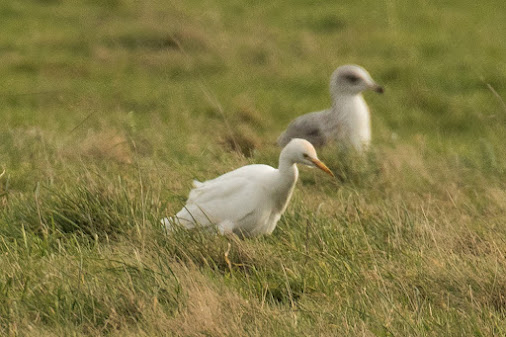


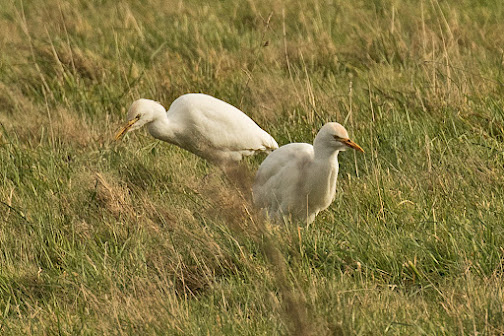

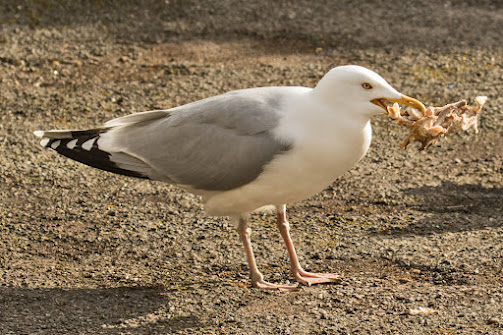
Being by myself now, I wasn't too sure what to do with the Chicken carcass I ended up with. pam had ensured that the freezer was full so that we would all be well fed at Christmas, even if she didn't make. Sadly we said goodbye on the 16th of December and I am left with 59 years of memories and a life that feels rather empty with out her. But thee Herring Gulls did benefit from my lack of enthusiasm for boiling up the remains and making soup.


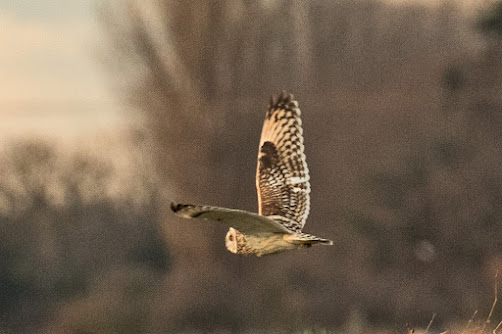
After a few days with no car it was good to get it back and take a wander this afternoon along the Ancient Highway. Short-eared Owls are mesmeric when they are hunting, and although this one never came very close it was well worth watching.



The un-ringed White Stork that has been frequenting the same field on Worth Marshes for several weeks.Occasionally it has taken a trip away, but returned later. Unfortunately on the occasion I've walked from Worth to the usual area it has been on an away trip both times. The first time it to a trip and flew over Kingsdown ns would possibly been a garden tick had I been at home. The second time wasn't so bad as it had move just a few hundred yards for where I had parked, and although I wasn't possible to get very close, I did get some good scope views.


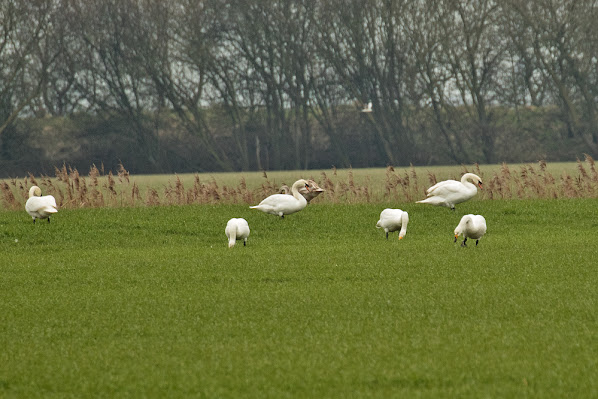
There are usually a few wild swans in Kent and in a group on Walland Marsh yesterday there were nine Bewick's, and five Whoopers grazing with around 30 Mutes. At one point one of each species were together. The left one is a Whooper, as big as a Mute, with the yellow on the bill going a long way down and finishing in a point. The Bewick's, is at the front, it is about 10% smaller with a smaller amount of yellow in the bill which in in a curve, behind is the Mute Swan. They were quite a long way away on a rather gloomy afternoon, so not the best photos, but they do show the differences quite well.

Two Mutes and a Bewicks.

Two Mutes, a Whooper and a Bewicks.

two Whoopers, a Bewick's and two Mutes.

two Whoopers, a Bewick's and two Mutes.


Cormorant

Cormorant and Moorhen.


After the very difficult Christmas and New Year I finally got enough enthusiasm to pick up my camera and met up with Jamie Partridge to lookatthe gulls in the Bay, with the specific intention of looking for Capsian Gulls. Jamie is a Caspain obsessive and very skilled at Gull ID, (and all other species), but itwas several loaves of bread later that a Caspaian Gull appeared amongst the Herring Gull multitudes.

Eventually Jamie drew my attention to a 2nd year bird. In flight the very white head, broad dark tail band with a very white upper tail were very striking. It settled on the rocks some way off.

It showed s0me very good features for Caspian Gull. The long parallel sided bill, Dark Eye, Longish legs and very full chest.
 |
The wings are long and the black patch in the tertials is a good character. |


